TVK CSA / EnteleAGENT
Quantum–Neural Cryptographic Security Architecture
Defensive research for AI agent identity, digital asset authorization, post-quantum cryptography and deterministic policy enforcement.
Research status: not a guarantee of deployed quantum-resistant signatures, production NeuroShield controls or independent certification. Intelligence is not authority.
Architecture and independent trust boundaries
Quantum migration
Research and interoperability testing for NIST ML-KEM, ML-DSA and SLH-DSA. Classical on-chain signatures are not automatically quantum-resistant.
Bounded machine identity
Machine and fleet authority should be identity-bound, scoped, revocable and separated from model-generated instructions.
Independent signing
A machine controller or compromised endpoint cannot authorize financial transactions simply by possessing an application credential.
NeuroShield research
Specialized evidence nodes monitor identity, wallet intent and AI risk; deterministic policy, not AI output, determines eligibility.
EIP-7702 controls
Unexpected delegation, code hash, operator or signing epoch should fail closed, with explicit revocation and containment procedures.
Security evidence
Track controls as designed, implemented, verified or independently assessed based on test and deployment evidence.
Compromised endpoint and withdrawal-service containment
Independent intent validation, code delegation restrictions, isolated signing, rate limits and reconciliation are essential even when private keys have not been exposed.
Security stages: designed → implemented → verified → independently assessed. See NIST post-quantum cryptography for the underlying standards.
Post-quantum cryptographic migration
Versioned inventory, protocol interoperability testing and secure key replacement are prerequisites for quantum-resilient systems. A wallet connected to an existing classical-signature blockchain does not automatically gain quantum-safe transaction signatures.
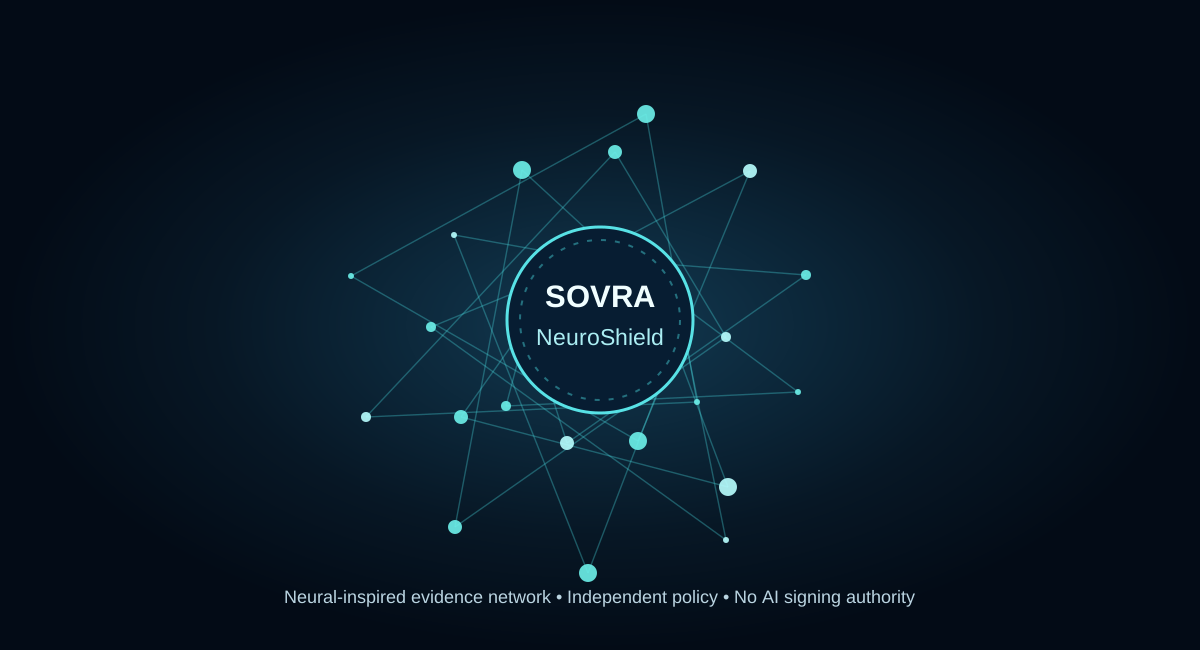
SOVRA NeuroShield evidence graph
Neural-inspired sensors contribute signed observations, but cannot sign transactions or create permission. Model compromise cannot substitute for cryptographic user and policy approval.
Security control evidence
Published architecture and diagrams are not proof of deployed controls. The machine-readable register records implementation verification as outstanding until supported by auditable evidence.
View the CSA control maturity register (JSON)